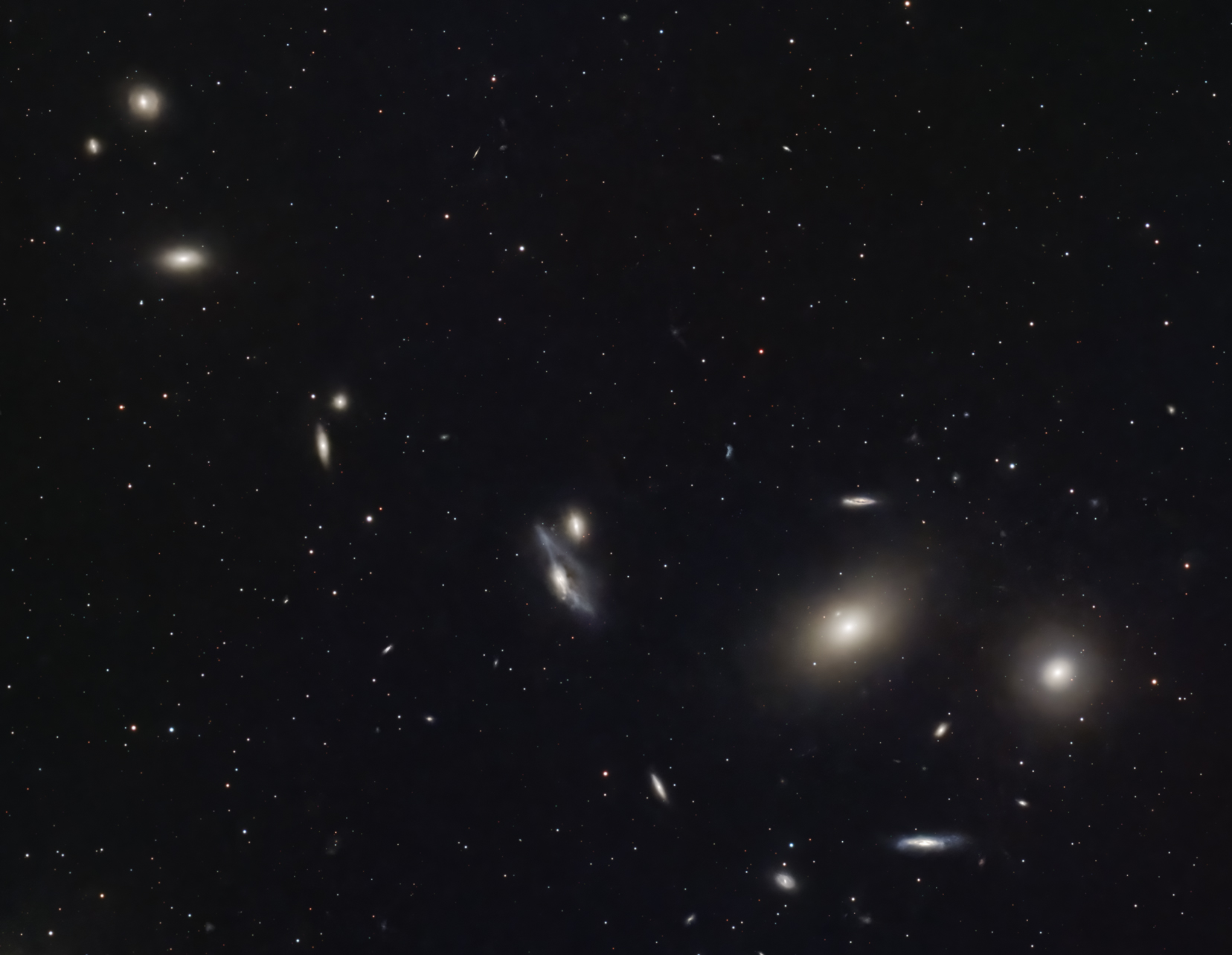
Markarian's
Chain
Characteristics:
RA (J2000): 12h 27m 48s
Dec (J2000): +13 degrees 17' 29"
FOV: Approximately 1.5 degrees (cropped from an original FOV of
approximately 6 x 4 degrees)
Description:
Markarian's chain was named after an Armenian astronomer in the 1970s
and represents an interesting stretch of galaxies that forms part of
the Virgo Cluster, located about 70 million light years away. Our
own Local Group of galaxies (Milky Way, large and small Magellenic
Clouds, M31, M32, M110, and M33) is receding from the Virgo Cluster at
a rate of about 1000 km/second. However, it is anticipated that
our Local Group will eventually stop receding from the Virgo Cluster
and will ultimately accelerate towards this region.
Photographic
Details:
Dates: March 17 and 18, 2026.
Scope: SV555 243mm lens (54mm aperture at f4.5) on
the ZWO AM3N mount. This is my new, portable set up.
Autoguider: ASI178 autoguider with SvBony 30mm guidescope, focal length
120mm.
Camera: ZWO ASI2600MC at -10C;
Pixel size 3.76 microns (Bin 1x1),
yielding an image scale with the SV555 (243mm focal length) of 3.19
"/pixel. This was reduced to 1.59 "/pixel by drizzle at scale 2
in post, in order to minimize the effects of undersampling.
Camera gain set to 100, offset
50. Read noise at this gain level was approximately 1.4 electrons
rms.
Filters: Antlia Triband (my new
imaging site is unfortunately Bortle 8, making a light pollution filter
resonable for broadband imaging, although given that most light
pollution these days is LED-based, I'm still not sure how much this
filter helps) .
Image acquisition
software: ASIAIR Plus (necessary for me now, since I need a
completely portable imaging rig that allows me to travel to a nearby
imaging site).
Exposures: Total
exposure 8 hours, 300 second
subs.
Processing:
Calibration,
integration, deconvolution (BlurXTerminator, used after drizzle),
noise reduction
(NoiseXTerminator) in
Pixinsight; subsequent processing in Photoshop.
Please
note: Graphics on this website may not be reproduced without
author permission.
Back to Galaxies
Home