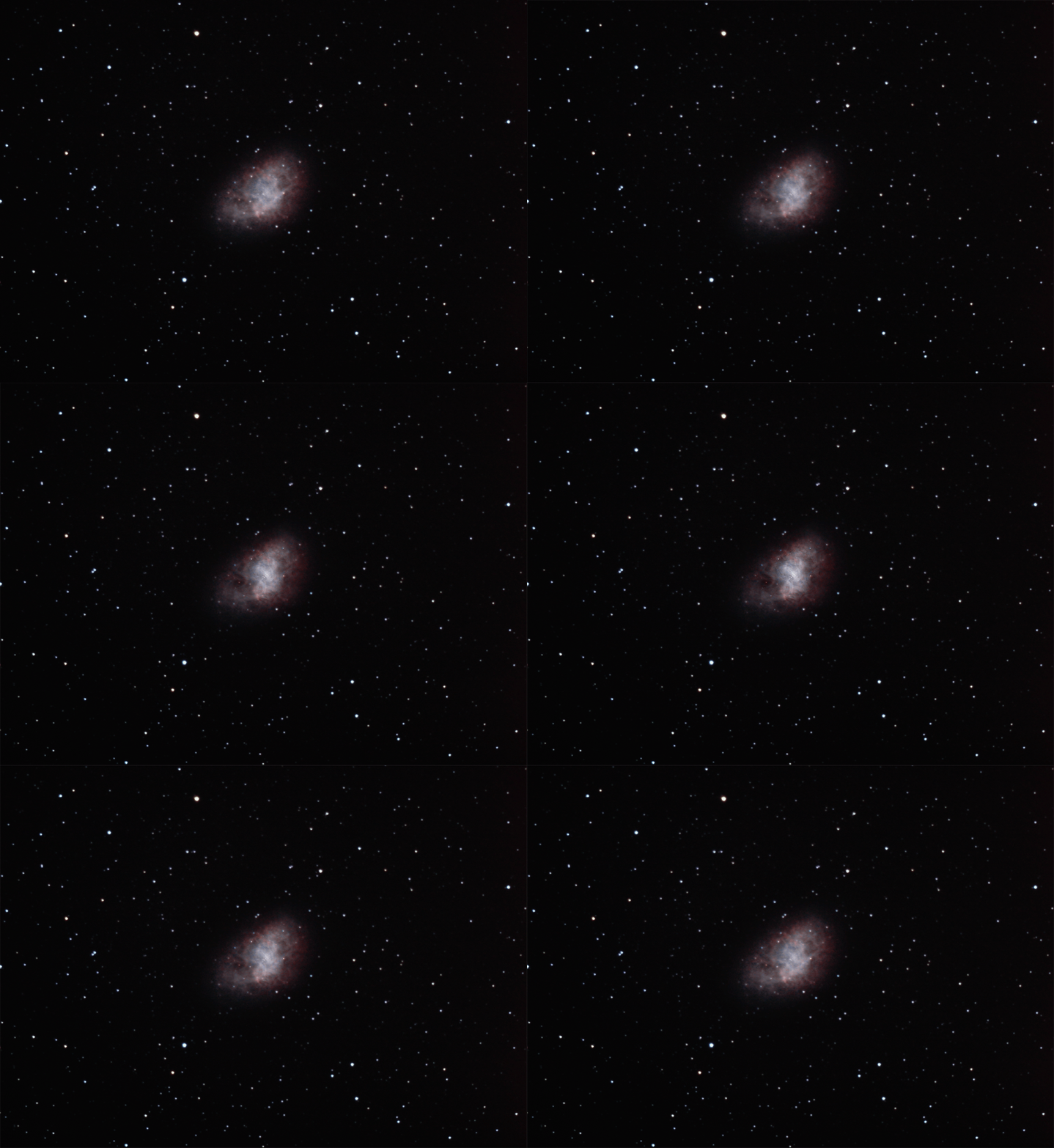
The Crab Nebula (M1)
 All Images Copyright Steve
Cannistra
Please
click here for a
higher resolution image.
Please
click here for
an animation using my image and a composite image from the Chandra
X-Ray telescope (large file!).
Please
click here
for a rollover showing the Chandra image superimposed over mine (hold
mouse over M1).
All Images Copyright Steve
Cannistra
Please
click here for a
higher resolution image.
Please
click here for
an animation using my image and a composite image from the Chandra
X-Ray telescope (large file!).
Please
click here
for a rollover showing the Chandra image superimposed over mine (hold
mouse over M1).
Characteristics:
Magnitude: 9.0
Distance: 6500 light years
RA: 5h 34m 44s
Dec: 22 degrees 01' 04"
Description:
The Crab Nebula is the first in Messier's long list of DSOs. It
is a gasseous remnant of a supernova explosion that was observed in
1054 AD, visible in the daytime sky for over 3 weeks before
fading. At the heart of the nebula is a pulsar (rapidly rotating
neutron
star) that spins at a rate of 30 times per second (first detected by
Jocelyn
Bell as a graduate student in 1968). The neutron star is a rich
source of electromagnetic radiation over a broad range of wavelengths,
including X-Ray, resulting in a dynamic view of this region as captured
by time lapse movies obtained by the Chandra
X-Ray Observatory. Supernova explosions such as this
generally occur when stars greater than 1.4 solar masses exhaust their
Hydrogen, Helium,
Carbon, Oxygen, Silicon fuels (in sequence) and are left with an Iron
core,
which cannot undergo fusion. The release of these elements via a
supernova explosion permits the secondary formation of solar systems,
planets, and lifeforms like ours. The iron that forms an
essential part of oxygen-carrying hemoglobin in our blood was forged
inside a star larger than our sun, and was released by a Supernova
explosion like the Crab Nebula. Here
is a link to more information about Stellar
Evolution.
Photographic Details:
Date: January 21, 2004
Scope: LX90 at f10 (no focal reducer).
Autoguider: STV with e-finder.
Camera: Canon 10D.
Filter: IDAS LPS.
Exposures: 16 x 5' at ISO 1600.
Conditions: Temperature 12 degrees F; good transparency; good
seeing; dry; calm.
Post-processing: Raw
conversion, adaptive dark frame calibration, alignment, min/max
excluded averaging done in ImagesPlus; Levels, curves, and layer mask adjustments in Photoshop.
Final sharpening using a Lucy-Richardson deconvolution algorithm
(7x7 setting, 5 iterations, noise threshold 2.0) in ImagesPlus.
There was very little vignetting at f10 (correction was not
necessary), and the STV/LX90/Superwedge combination tracked quite well
even at f10. Animation
for Crab movie was constructed using my photo plus an X-Ray, Optical,
and
Radio composite from the Chandra
X-Ray Observatory in ImageReady (component of Photoshop). This composite
was used as a luminance layer in the movie, in order to show how the
visual
light structure of my original image corresponds to the X-Ray structure
of the Chandra image.
Please
note: Graphics on this website may not be
reproduced without author permission.
Back to Nebulae
Home