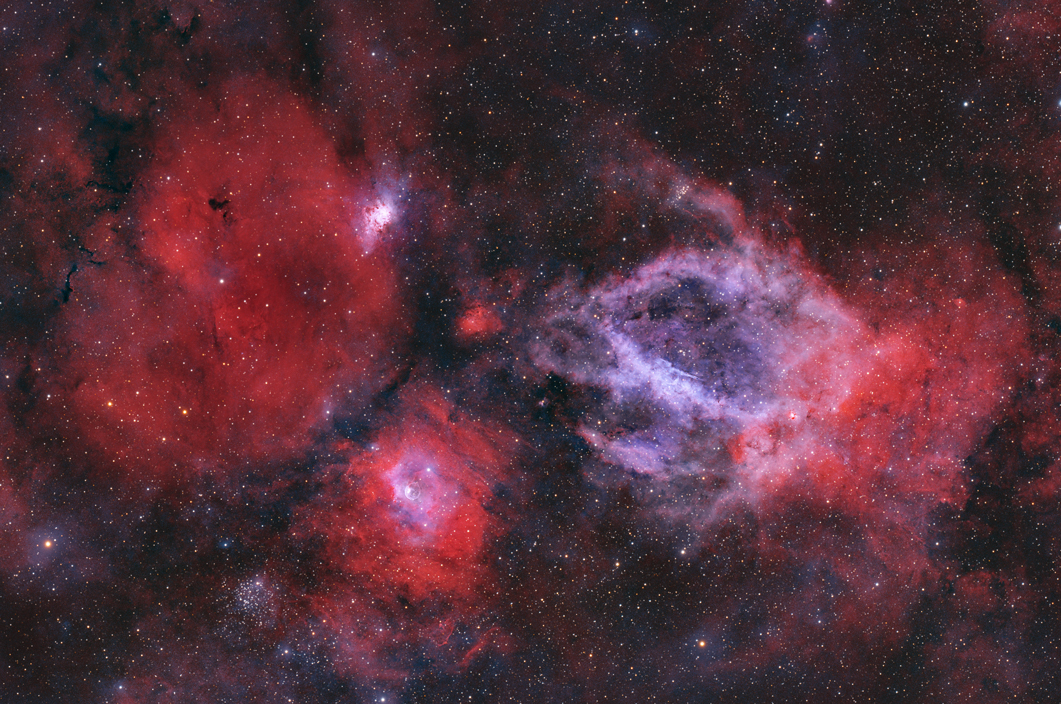
Sh2-157 (Lobster
Claw Nebula Region)
Coordinates (approximate):
RA (J2000): 23h 16m 29s
Dec (J2000): +60 degrees 53' 51"
Description:
Sh2-157,
popularly known as the Lobster Claw Nebula, is a complex star-forming
region in Cassiopeia where intense ultraviolet radiation and powerful
stellar winds from the Wolf-Rayet star WR 157 have sculpted,
compressed, and ionized the surrounding interstellar gas, resulting in
the shapes seen in the above image. Rather than being a flat
structure, the nebula is best understood as an expanding, asymmetric,
ellipsoidal shell whose "lobster pincers" are simply the
limb-brightened edges of this
three-dimensional shell that are projected onto the two-dimensional
plane of the
sky. Such shells are common in wind-blown nebulae and supernova
remnants (including the Bubble Nebula and the Cygnus Loop), with their
bright borders representing regions where our line of sight passes
edge-on through the greatest amount of emitting material.
Variations in the density of the surrounding molecular cloud have
caused the shell to expand unevenly, producing its distinctive
fragmented appearance and apparent openings where hot stellar winds
have broken through into lower-density regions. The image was
taken using a dual HaOIII filter, with hydrogen emission mapped to red
and oxygen emission mapped to blue and green, revealing regions where
ionized gas radiates under the influence of intense ultraviolet
radiation from WR157. Other stars
contribute to this excitation process as well, including massive O- and
B-type stars of the Cas OB2 association and young stars within the
Markarian 50 cluster. Sh2-157 remains an active stellar nursery,
where
dense pockets of molecular gas continue to collapse and form new
generations of stars.
Photographic
Details:
Dates: June 8, 13, and 19, 2026.
Scope: SV555 243mm lens (54mm aperture at f4.5) on
the ZWO AM3N mount. This is my new, portable set up.
Autoguider: ASI178 autoguider with SvBony 30mm guidescope, focal length
120mm.
Camera: ZWO ASI2600MC at 0C;
Pixel size 3.76 microns (Bin 1x1),
yielding an image scale with the SV555 (243mm focal length) of 3.19
"/pixel.
Filter: SvBony HaOIII 7nm Dual
Narrowband filter .
Image acquisition
software: ASIAIR Plus (necessary for me now, since I need a
completely portable imaging rig that allows me to travel to a nearby
imaging site).
Exposures: Total
exposure 9.5 hours, 300 second
subs.
Processing:
Calibration
and
integration in Pixinsight. Separation of image into Ha and OIII
components using DBXtract. Assembly of HOO image in Pixinsight,
followed by separation of stars/nebula components using
StarXTerminator. Deconvolution (BlurXTerminator),
and noise reduction
(NoiseXTerminator) in
Pixinsight. Subsequent processing in Photoshop.
Please
note: Graphics on this website may not be reproduced without
author permission.
Back
to Nebulae
Home