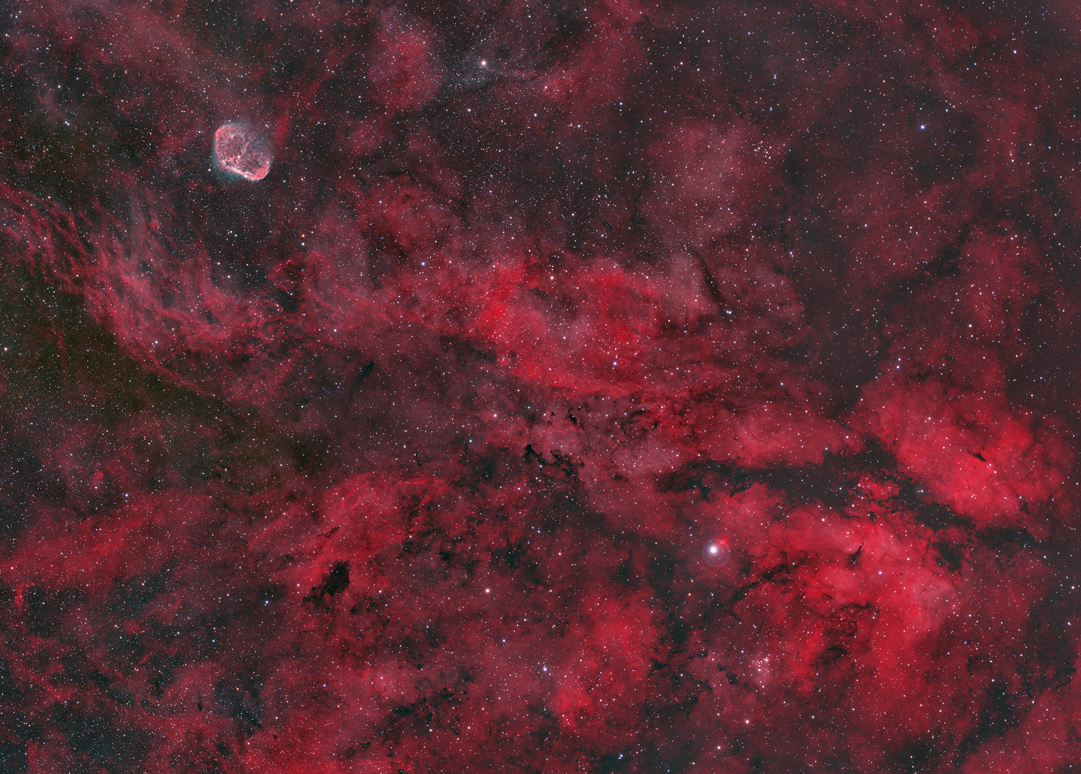
Gamma
Cygni Nebula and NGC6888 (Crescent Nebula)
Characteristics:
RA (J2000): 20h 19m 32s
Dec (J2000): +39 degrees 35' 08"
Description:
The Gamma Cygni Nebula is an expansive emission region in the
constellation Cygnus, shown here as an HOO image using a dual HaOIII
filter (more details below). The star Sadr (aka Gamma Cygni) is
the brightest in this field of view, seen in the right lower quadrant
of this image, and is actually not part of the nebula itself, being in
the foreground and located approximately 1,800 light years away. In
contrast, the IC1318 nebula is more distant at 5,000 light years away
and emits Ha and OIII light as a result of being ionized by intense UV
irradiation from many highly luminous Cygnus OB2 association
stars embedded within the nebula. These stars are not easily
observed in this image due to the obscuring effects of intervening dust
throughout this region. The entire nebula is a stellar nursery in
which stars are being formed as a result of gravitational collapse of
surrounding hydrogen gas (and other heavier elements such as helium and
oxygen). Also seen in this image is the Crescent Nebula
(NGC6888) in the left upper quadrant, an emission nebula excited by
intense UV irradiation from
its central star, WR136. Wolf-Rayet 136 has shed its outer,
hydrogen layers and is burning helium in its core, and is expected to
have a lifespan of only several million years (compared to our Sun,
which is a lower mass G2V star with an expected lifespan of 10 billion
years). I previously imaged the Crescent Nebula at a longer focal
length and also obtained the spectrum of WR136, shown here.
More information about this interesting region can be seen on Rob
Gendler's Website .
Photographic
Details:
Dates: June 1 and 3, 2026.
Scope: SV555 243mm lens (54mm aperture at f4.5) on
the ZWO AM3N mount. This is my new, portable set up.
Autoguider: ASI178 autoguider with SvBony 30mm guidescope, focal length
120mm.
Camera: ZWO ASI2600MC at 0C;
Pixel size 3.76 microns (Bin 1x1),
yielding an image scale with the SV555 (243mm focal length) of 3.19
"/pixel.
Filter: SvBony HaOIII 7nm Dual
Narrowband filter .
Image acquisition
software: ASIAIR Plus (necessary for me now, since I need a
completely portable imaging rig that allows me to travel to a nearby
imaging site).
Exposures: Total
exposure 8 hours, 300 second
subs.
Processing:
Calibration
and
integration in Pixinsight. Separation of image into Ha and OIII
components using DBXtract. Assembly of HOO image in Pixinsight,
followed by separation of stars/nebula components using
StarXTerminator. Deconvolution (BlurXTerminator),
and noise reduction
(NoiseXTerminator) in
Pixinsight. Subsequent processing in Photoshop.
Please
note: Graphics on this website may not be reproduced without
author permission.
Back
to Nebulae
Home